South Africa Salary & Employment Guide
Key Income Statistics
R29,690per month
Average monthly earnings in the formal non-agricultural sector. This excludes agriculture, informal-sector work, and self-employed earners, so it understates the full labour market.
Source: Stats SA — Quarterly Employment Statistics (QES) · November 2025
R30per hour
A single national rate that also covers domestic and farm workers. Expanded Public Works Programme (EPWP) workers have a separate, lower rate of R16.62/hour.
Source: South African Government News Agency (SAnews) · Effective 1 March 2026
Highest-Paying Sectors in South Africa
Finance, insurance, real estate & business services
The highest-paying sector by average monthly earnings, per Stats SA's QES industry breakdown.
Electricity, gas, steam & water supply
Second-highest average monthly earnings in the QES data.
Computer and related activities
Among the top-paying sectors tracked by Stats SA.
Mining
Widely regarded as high-paying in industry commentary, though not broken out with a precise figure here.
Specialist healthcare
Senior medical specialists are frequently cited as high earners in recruitment-industry reports, rather than national statistics.
South Africa's Tax System Explained
South Africa taxes employment income through PAYE, administered by SARS, using progressive tax brackets and an annual primary (and age-based) rebate rather than a tax-free band. Employees also pay UIF, a small, capped contribution matched by the employer.
Workplace & Payroll Rules
Employment Law Essentials
Under the BCEA, employees are entitled to at least 21 consecutive days of paid annual leave per 12-month cycle. Statutory notice periods scale with tenure: 1 week (up to 6 months' service), 2 weeks (6 months to 1 year), and 4 weeks (over 1 year). The BCEA itself sets no fixed probation length — probation duration is governed by the Labour Relations Act's Code of Good Practice, which requires only that it be "reasonable" for the role; 3 months is common by convention, not law.
Source: Basic Conditions of Employment Act 75 of 1997 (Sections 20 & 37)
Payroll Cycle & Frequency
Monthly pay is the norm for salaried employees, though the BCEA permits daily, weekly, fortnightly, or monthly intervals. Wages must be paid within 7 days of the end of the relevant pay period, and employers must issue written particulars of remuneration (a payslip) every pay period.
What Salaries Cover in South Africa
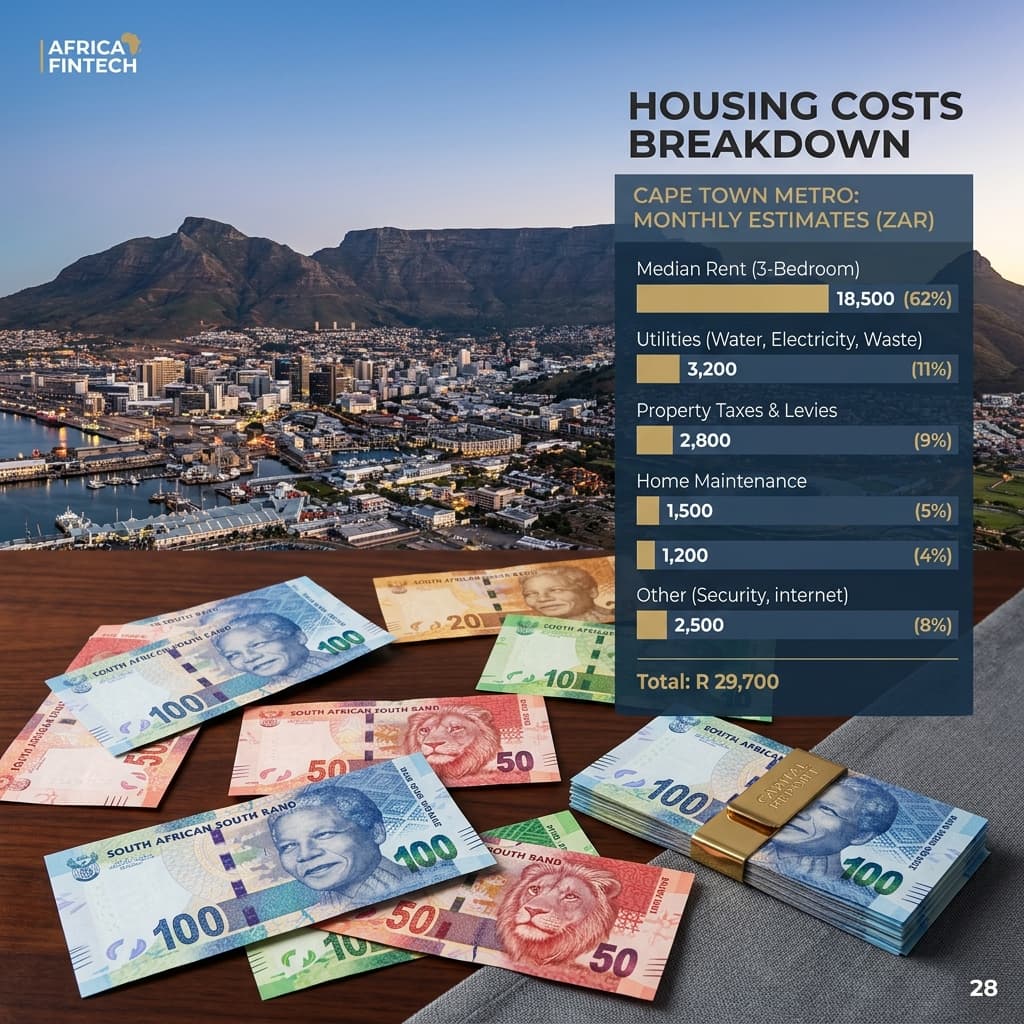
Rent varies significantly by city: crowdsourced data suggests a one-bedroom flat in central Cape Town runs noticeably higher than an equivalent unit in Johannesburg. Informal budgeting guides commonly suggest R25,000–R35,000 a month for a single person to live comfortably in Cape Town — a rule of thumb from relocation/property commentary, not an official statistic.
Take-Home Pay Example
On a gross salary of R30,000/month (R360,000/year):
- Gross Salary
- R30,000/moR360,000/yr
- PAYE Income Tax
- R4,681/moR56,172/yr
- UIF (Unemployment Insurance Fund)
- R177/moR2,125/yr
- Effective Tax Rate
- 16.2%
Employer pays
Total fund contribution