Key Income Statistics
KSh77,758per month (average, formal wage employment)
A mean, not median, and specific to formal wage/salaried employment (about 3.4 million people) — not per-capita income for the whole population. Private-sector average was higher, at roughly KES 80,550/month, versus roughly KES 71,783/month in the public sector.
Source: Kenya National Bureau of Statistics — Economic Survey 2025 · 2024
KSh16,114per month (general labourer, major cities)
This is the basic wage, exclusive of housing allowance — employers who don't provide free accommodation owe a further 15% on top. Kenya's minimum wage is also tiered by occupation and location: this is the general-labourer rate for Nairobi, Mombasa, Kisumu, Nakuru, and Eldoret, and skilled occupations and other towns have their own rates across 15 occupational grades.
Source: Regulation of Wages (General) (Amendment) Order, 2024 (Legal Notice No. 164) · Effective 1 November 2024
Highest-Paying Sectors in Kenya
International organisations & multilaterals
The highest-paying category in KNBS data, at roughly KES 353,000/month average — driven by UN agencies and similar bodies.
Electricity, gas, steam & air conditioning supply
Roughly KES 205,000/month average in the private sector.
Financial and insurance services
Roughly KES 198,000/month average.
Administrative and support services
Roughly KES 164,000/month average.
Professional, scientific and technical activities
Roughly KES 149,000/month average.
Kenya's Tax System Explained
Kenya taxes employment income through PAYE, administered by the Kenya Revenue Authority, after three mandatory deductions are subtracted from gross pay: NSSF (pension), SHIF (health insurance), and the Affordable Housing Levy. PAYE is then applied in progressive bands with a personal relief reducing the final tax owed.
Workplace & Payroll Rules
Employment Law Essentials
Under the Employment Act, 2007, employees get at least 21 working days of paid annual leave after 12 consecutive months of service. Standard monthly-paid employees are entitled to 28 days' written notice on termination. Probation is capped at 6 months, extendable once by agreement to a 12-month total, with as little as 7 days' notice permitted during the probationary period itself.
Source: Employment Act, 2007 (Cap. 226), Sections 28, 35 & 42
Payroll Cycle & Frequency
Monthly payroll is the norm for formal employment, reflected in the Act's own 28-day notice rule for monthly-paid staff. Wages must be paid in Kenyan currency on a working day, at or near the workplace, and employers must give a written itemised pay statement at or before each payment (casual and short-term contracts are exempt from this last requirement).
What Salaries Cover in Kenya
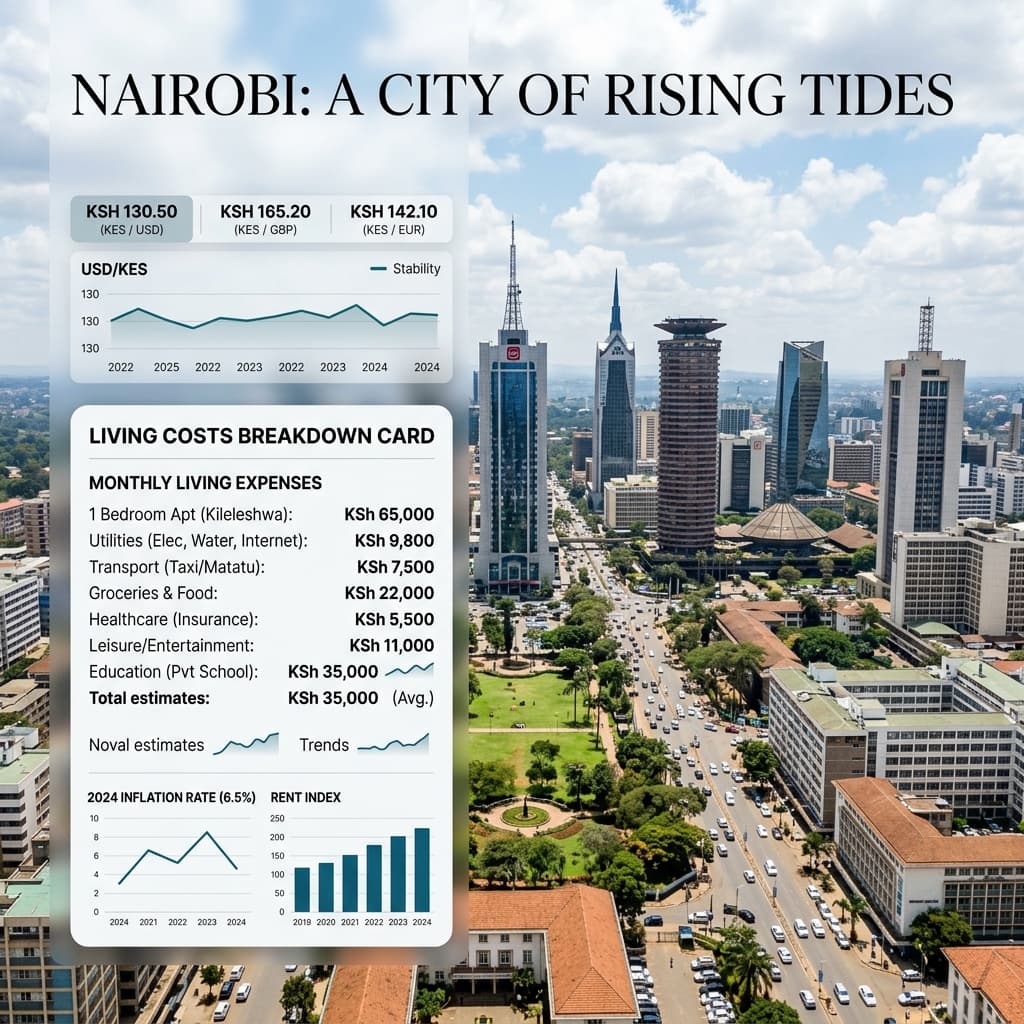
Rent in Nairobi varies widely by neighbourhood: roughly KES 37,000-80,000 a month for a one-bedroom flat in the city centre, versus KES 20,000-40,000 in more affordable areas like Donholm, Kasarani, or Ruiru. Cost-of-living guides estimate a comfortable single-person monthly budget, including rent, at roughly KES 70,000-120,000 in a mid-range neighbourhood.
Source: Wise — Cost of living in Nairobi, Kenya (aggregator estimate, not government data)
Take-Home Pay Example
On a gross salary of KES 100,000/month:
- Gross Salary
- KSh100,000/moKSh1,200,000/yr
- PAYE Income Tax
- KSh19,308/moKSh231,700/yr
- NSSF Employee Contribution
- KSh6,000/moKSh72,000/yr
- SHIF (Social Health Insurance Fund)
- KSh2,750/moKSh33,000/yr
- Affordable Housing Levy
- KSh1,500/moKSh18,000/yr
- Effective Tax Rate
- 29.6%
Employer pays
Total fund contribution
Employer pays
Total fund contribution