₦70,000 a month, checked against real Lagos rent and living costs.
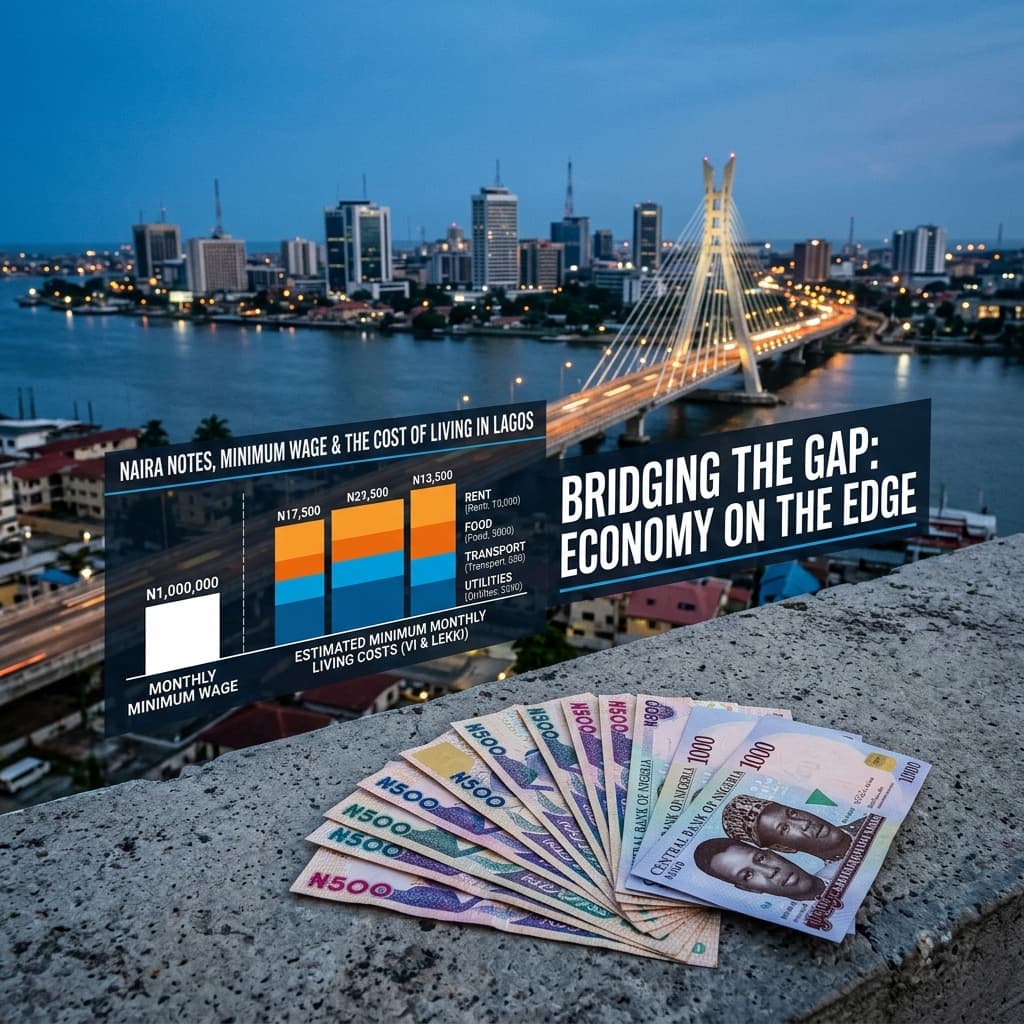
Nigeria doesn’t currently have a reliable, independently verifiable national average-salary figure — the National Bureau of Statistics’ last comparable income survey predates the 2023-2024 naira devaluation, so we’re not going to quote a number here that we can’t stand behind. What is verified is the National Minimum Wage: ₦70,000 a month. Here’s what that has to cover in Lagos.
The numbers
A one-bedroom apartment in Lagos ranges from roughly ₦120,000 a month on the mainland to ₦350,000 or more in Ikoyi, Victoria Island, or Lekki Phase 1. Even at the cheapest end, rent alone runs about 1.7 times the entire national minimum wage — before food, transport, or anything else.
Crowdsourced cost-of-living data puts a single person’s other monthly costs (excluding rent) at roughly $500, or somewhere around ₦689,000 at recent exchange rates — many multiples of the ₦70,000 wage floor on its own.
The upfront-rent problem
There’s a structural detail that makes this worse than the monthly numbers alone suggest: Lagos landlords commonly demand 1-2 years of rent paid upfront, rather than monthly. The Lagos State Tenancy Law caps how much advance rent can be demanded, but the practice persists widely regardless. For a minimum-wage earner, that means the barrier to renting at all isn’t just affordability — it’s raising a lump sum equivalent to a year or more of the minimum wage in one payment.
Some employers pay above the federal floor — Lagos State itself pays its own workers ₦85,000 a month, higher than the ₦70,000 national minimum — but even that gap doesn’t close the distance to Lagos rent shown above. If you want to see what a specific salary becomes after PAYE and pension deductions, this site’s Nigeria salary calculator can run the numbers for you.